The review-first workspace for coding agents

A calmer way to
ship a backlog.

Dispatch the whole backlog at once — every agent on its own git worktree, wired to the tools you already use. You come back to a review queue, not a wall of files. Everything ships as a PR you approve.
Open in browser →
v0.4.2 · macOS launches soon · Windows & Linux to follow · Free while in beta
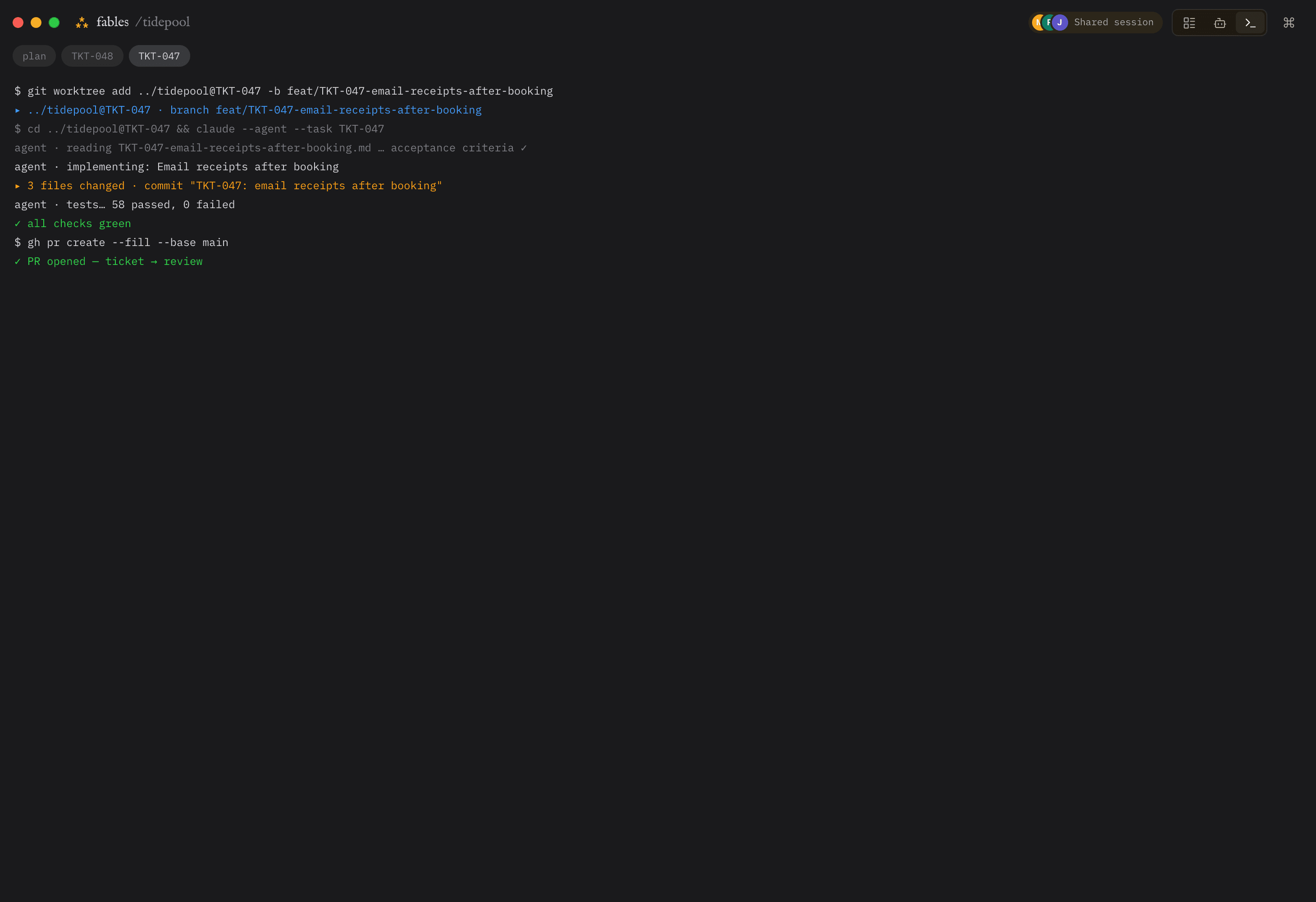
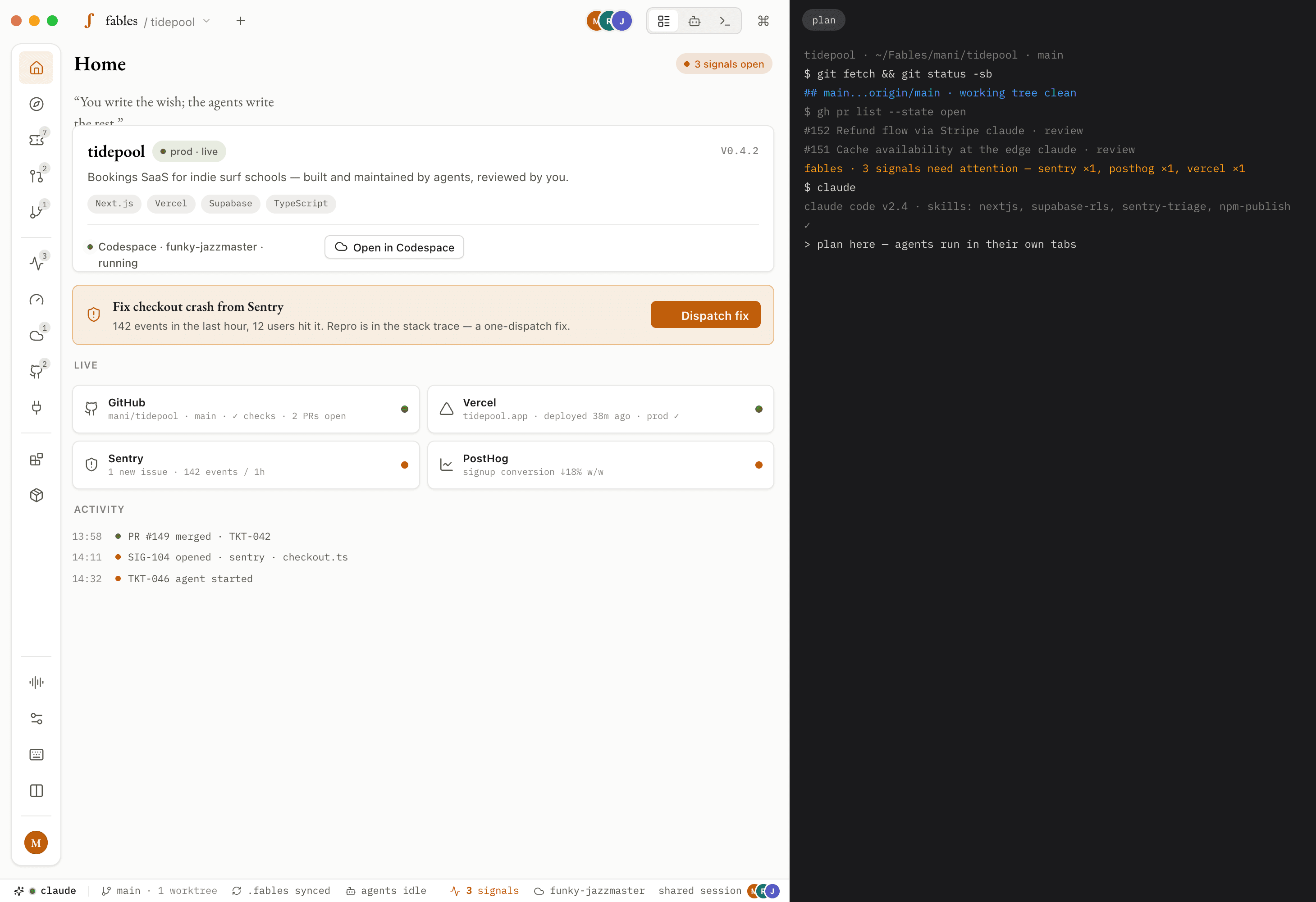
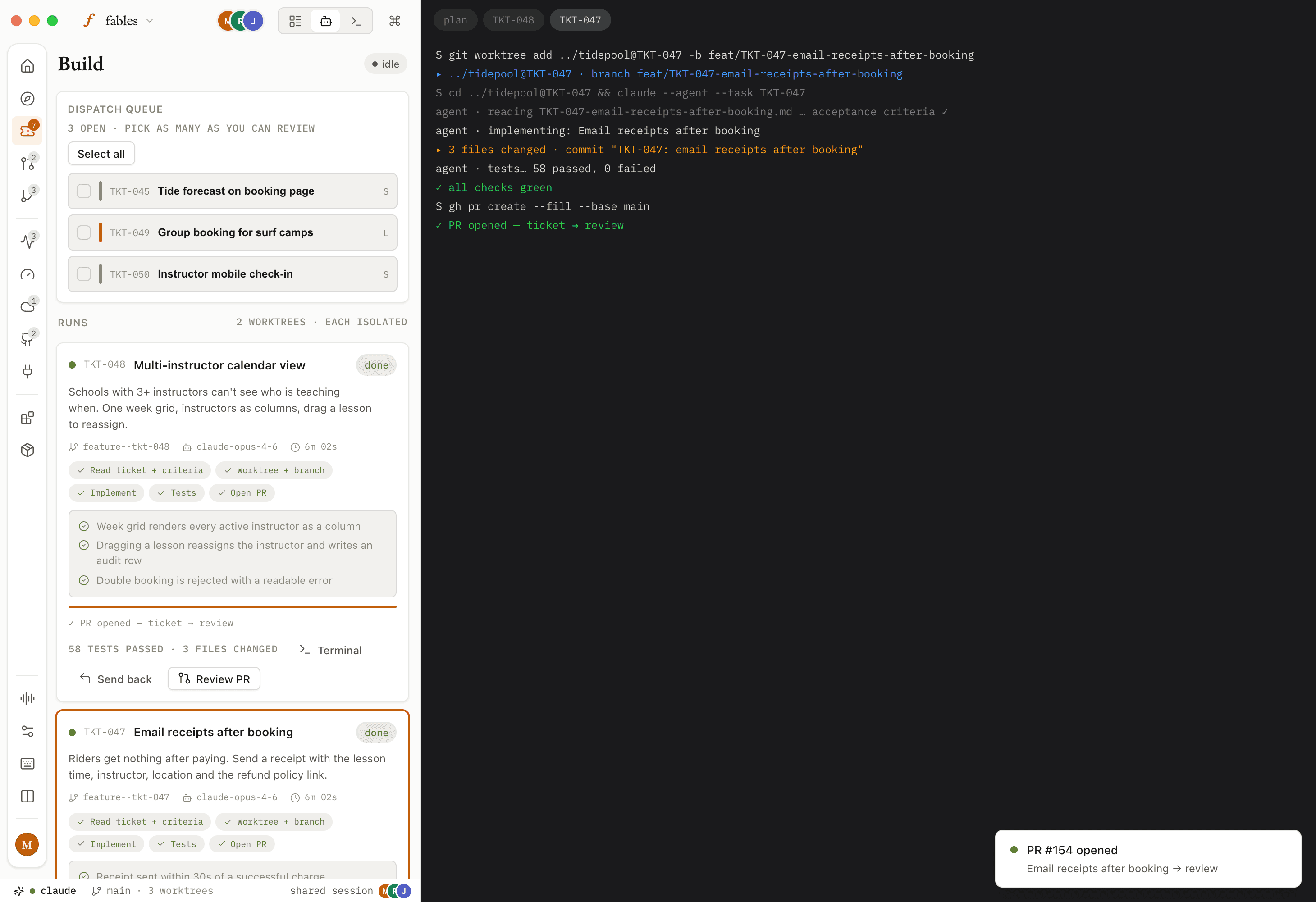
fables in Plan mode — the project, live signals and the terminal docked rightfables in Build mode — an agent running in its own worktree, streaming into the terminalfables in Terminal mode — the terminal full screen
Works with the tools you already work with
GitHubLinearJiraSupabaseVercelSentryPostHognpmExpoClaude CodeACP
Orchestration, not micromanagement

Shape the work. Let the agents do it.

Coding agents got good at writing code. What they didn’t bring is a way to run six of them at once, keep them working from the same brief, and hand you back something you can actually judge. That’s the whole of fables.

Six agents, six branches, one review queue

Dispatch the whole backlog at once. Each ticket gets its own agent and its own git worktree, so nothing collides. You come back to a queue — diff, tests, risk — and merge or send it back in a keystroke.

01Parallel by default. The limit becomes your judgement, not your typing speed.
02Queue it before bed; wake up to work that has already run the tests.
03Send one back with a note and the agent resumes in the same worktree.
#152 Refund flow via Stripe 58 tests ✓
#151 Cache availability at the edge ready
#150 Waitlist when a slot frees sent back · 1 note
TKT-207 Partial refunds — e2e cover running 4m
4 dispatched overnight · 3 waiting on you

From ticket to pull request, on its own branch

Plan tickets from Linear, Jira, or GitHub Issues. Dispatch an agent and it spins up an isolated git worktree, implements, writes tests, and opens a PR for you to review.

01Every agent runs in its own worktree — no stepping on your working tree.
02Swarm a backlog: dispatch many tickets at once, each to its own branch.
03You review diffs and merge with gh — nothing proprietary in the loop.
TKT-204 Refund flow via Stripe PR ready
TKT-205 Cache availability at the edge agent running
TKT-206 Waitlist when a slot frees open
SIG-12 Fix checkout crash agent running

Every signal becomes a fix

Sentry crashes, PostHog drop-offs, Vercel build failures — they all surface in one place. One click turns an incident into a tested pull request with the repro baked in.

01The agent pulls the real event payload and writes a failing test first.
02You see the root cause in the stack trace, not a vague summary.
03Verified against the source signal before the PR opens.
Sentry
Checkout crash — null dispatch
142 events · 12 users in the last hour
PostHog
Signup drop-off on step 2
Conversion down 18% week-over-week
Vercel
Preview build failing
Type error in app/api/route.ts

A terminal that's just a terminal

Edge-to-edge, full-screen when you want it. Real git, gh, npm, and claude — nothing to relearn, nothing flaky to wrap. The agents drive the same shell you do.

01No proprietary CLI. What you type is what ships.
02SSH straight into GitHub Codespaces when you sign in with GitHub.
tidepool · ~/dev/tidepool · main
$ git worktree add ../tidepool@TKT-204 -b feat/refunds
▸ ../tidepool@TKT-204 · branch feat/refunds
$ claude --agent --task TKT-204
agent · acceptance criteria ✓ · writing tests
✓ 58 passed, 0 failed
$ gh pr create --fill --base main
✓ PR opened — ticket → review

Bring any agent. fables speaks ACP.

Claude Code is native and available today — sign in and sessions, skills, tools and subagents are first class. The rest arrives over the Agent Client Protocol, the open standard between editors and agents, so adding an agent becomes a connection rather than a rewrite.

01Claude ACP is the default and the only agent enabled at launch.
02Codex, Gemini CLI and your own agent land next — same queue, same review.
03Because it’s an open protocol, a run can move between agents without losing context.
claude code ACP · native · skills, subagents default
codex over ACP coming soon
gemini cli over ACP coming soon
your agent ACP + SDK coming soon

The record of how your team ships

Every run leaves a trail: the intent it started from, the context it was given, what it changed, what the tests proved, who approved it, and what happened after deploy. Your history of shipping with agents, in one place.

01Ask “why is this code like this?” and get the original intent, not a commit message.
02fables learns which files break things, which reviews catch what, which runs get reverted.
03It compounds per team — the longer you ship here, the better the review gets.
Intent
Refund a booking without a support ticket— from TKT-204
Context
stripe/*, booking schema, refund policy doc
Agent
claude-opus-4-6 · 2 human redirects · 6m 12s
Evidence
58 tests passed · no e2e for partial refunds
Approved
mani · PR #152 merged to main
Outcome
deployed 38m ago · no incidents · 14 refunds processed

Velocity nobody had to report

Because every run is recorded, the numbers come for free — what shipped, how long review took, which runs came back. Then fables reads the week and tells you what it means: where the time actually went, what’s slowing you down, who is carrying what.

01Team and per-contributor velocity, measured from merged work rather than tickets moved.
02An AI read of your contributions: what you shipped, what you unblocked, what stalled.
03Honest signals — first-pass approval and revert rate, not lines of code.
34▲ 22%
PRs merged this week
96▲ 41%
Agent runs dispatched
71%▲ 6%
Approved first pass
2%▼ 3%
Reverted after deploy
This week, read by fables

Most of the agent time went to the refunds epic, and it moved. Review is now the slowest step — PRs waited 9h on average, twice last week. Two runs came back for the same missing e2e cover; worth a skill.

One workspace, the whole team in it

Open a project and you see who else is in it — and where. Attach to a running agent’s terminal and watch the same stream your teammate is watching, then hand the review over without a screen share.

01Presence across the workspace: who is in review, on the board, or in a terminal.
02Shared terminal sessions — two people, one worktree, no “can you paste that output”.
03Tickets, dispatch and review are all one queue, so handover is a click not a meeting.
MmaniReview · PR #152
RrobTerminal · TKT-046 · attached
JjimmyWork · board
MRJ3 here · shared session on tidepool
More than an editor

Everything around the code, in one place.

Σ

Skills from the store

Add official Claude skills — Next.js, Supabase RLS, Sentry triage — and your agents follow your conventions automatically.

Ship it out

Cut a version and publish to npm with provenance, or push a Vercel and Expo build — tracked in the workspace.

Web or mobile

Scaffold a Next.js app on Vercel, or a mobile app via Expo with EAS builds — Supabase linked from the first commit.

Tickets without ceremony

A board with room to read: description, acceptance criteria and estimate on the card. Tick several, dispatch them in parallel, review them as one queue.

Worktrees, managed

See every active branch and agent at a glance. Open, review, or clean up worktrees without leaving fables.

SDK & CLI

Script the workspace. Dispatch runs, read the record, and wire fables into CI with a typed SDK and a fables command.

Ambient focus

Soft rain, surf, or fire to stay in flow. A quiet companion for long sessions, not another thing shouting for attention.

ƒ

Your stack, connected

GitHub, Linear, Jira, Supabase, Vercel, Sentry, PostHog — wired in once, used everywhere across the workspace.

Product, defined once

Specs, goals and screenshots live in the workspace and sync to your repo — so every agent works from the same brief.

“You write the wish; the agents write the rest.”
Prompts and code, questions and answers — all poetry in fables
Free while in beta

Ship with fables.

Register your interest and we’ll email you the moment your platform is ready.

Windows & Linux builds coming soon.

Launches soon
macOS
Apple silicon & Intel · macOS 13.0+